New Canadian research is helping educators prevent bullying before it changes a child’s life
Date published: 2026-09-01 12:00:00
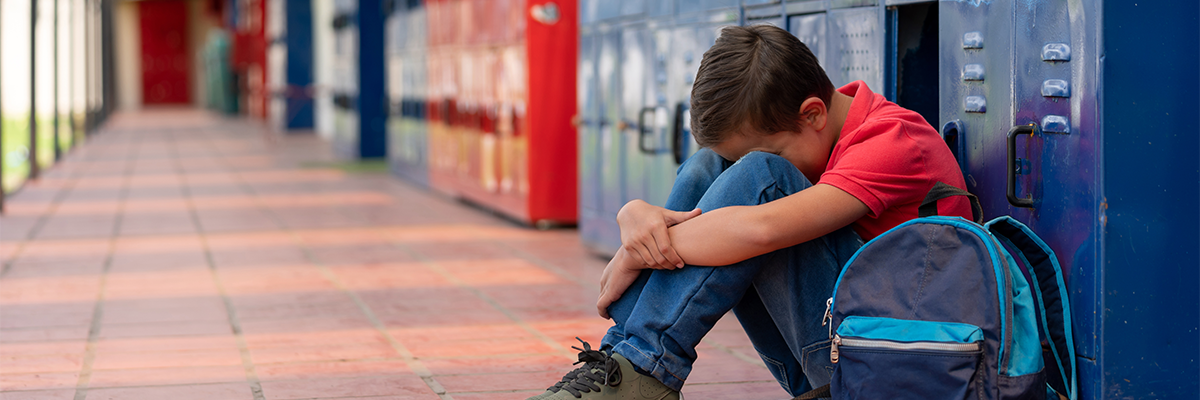
A boy cries in front of lockers in a school hallway.
Photo: andresr
Every September, millions of Canadian children walk through school doors carrying backpacks, lunch bags, and hope for a fresh start.
Some also carry something much heavier: fear.
“For too many children and youth in Canada, bullying is still a very real and common problem in our schools,” says Canada Research Chair in Childhood Health Promotion and associate professor of psychology at the University of Calgary, Deinera Exner-Cortens.
Recent Canadian research suggests that, in a classroom of 35 students, as many as 12 or 13 children may be experiencing or engaging in bullying behaviour.
Bullying isn’t a rite of passage. Exner-Cortens says it’s a public health issue with lifelong consequences.
“There are epigenetic changes that can happen when the chronic stress caused by bullying occurs,” says Exner-Cortens. “It truly gets under the skin.”
Supported by the Canada Research Chairs Program, Exner-Cortens and her team at the University of Calgary are helping schools move beyond reacting to bullying and toward preventing it before it starts.
“We believe that schools should be a place of inclusion and well-being for every student,” says Exner-Cortens. “If you’re not proactively figuring out how you’re going to deal with bullying, you’re not going to be that place.”
An injustice worth solving
“Over the Bridge, After Wiseguyz” HOPELab participant-made art.
Photo: Merman
Exner-Cortens’ career began with a seemingly straightforward question: Why does violence happen, and how can it be prevented?
“I felt that violence and bullying involving our youth was just really unjust. I wanted to be part of helping to find solutions," she says.
Today, Exner-Cortens leads the HOPELab at the University of Calgary; serves as scientific director of PREVNet, Canada’s national knowledge mobilization network for bullying and teen dating violence prevention; and works alongside graduate students, postdoctoral fellows and research staff to better understand bullying and translate research into practical solutions for schools and teachers across Canada.
Why bullying isn’t just about mean kids
For decades, bullying was often treated as conflict between individual students. Exner-Cortens says that understanding misses what’s really happening.
“It’s not just a kid being mean for the heck of it," Exner-Cortens explains. "They are smartly and strategically using these social power imbalances to gain popularity and get things that they want.”
Those power imbalances are often rooted in race, gender, disability, sexual orientation or body size, meaning identity-based bullying reflects broader inequalities that exist inside and outside the classroom, requiring a different response from schools.
“For bullying, we really focus on working with adults,” she says. “They are the ones who really need to be ready to notice it, to help students recognize what it is, to intervene and to stop it.”
“Asking children who are already being bullied to solve the problem themselves is really difficult, because they’re already in a relationship where they have less power,” she explains.
The first step is simply noticing
Exner-Cortens says educators must always be on high alert.
“If you notice that one kid always seems to be put to the side or is a bit withdrawn, just be curious and ask questions,” she says. “Adults really have a critical role to play in the solution.”
Her team’s research is already shaping classrooms.
Through PREVNet and alongside educators, five research teams from across Canada worked together to develop free identity-based antibullying training and classroom resources that help educators recognize bullying, reflect on unconscious biases, and create more inclusive learning environments.
“After Wiseguyz” HOPELab participant-made art.
Photo: Jeff Grizzly
“The first step in intervention is to notice,” she says. “If you’re not attuned to how some of these power dynamics play out, it’s easy to not notice what’s happening.”
The goal isn’t simply to respond when bullying occurs, but to build school cultures where it is less likely to happen in the first place.
“Wearing a pink shirt on one day for antibullying awareness doesn’t go far enough,” she says. “It has to be in every classroom, every day.”
Research that reaches beyond the classroom
The stakes couldn’t be higher. Bullying no longer ends when the school day does. It follows many children home through technology and social media.
Exner-Cortens says bullying isn’t just a social or educational issue, it’s a public health issue. She points to emerging research that shows bullying can have lasting consequences for mental and physical health, increasing the risk of anxiety, depression, chronic disease and even premature death later in life.
“We know that this is a huge health burden, and it’s an inequitable burden, because the health impacts fall much more heavily on marginalized Canadians,” she adds. “That’s why this sustained research funding is really important—because we need effective solutions.”
Building schools where every child belongs
As another school year begins, Exner-Cortens hopes educators will see bullying prevention as more than an added responsibility. She believes it is central to what schools are meant to do.
“Bullying prevention needs to be part of the core mission and policies of every school,” Exner-Cortens says. “Just like teaching math, reading and writing—promoting safe and caring environments must be part of the everyday curriculum.”
That’s because every child, she says, deserves to walk through the school doors carrying hope, not fear.
“No student should dread coming to school every day," she says.
Want to learn more?
Check out the PREVNet identity-based bullying online training for educators, identity-based bullying teaching resources, and key facts on bullying.